Showing posts with label Italy. Show all posts

Tuesday, May 03, 2011

An Italian village that welcomes refugees from North Africa

Many people leave the North shores of Africa on boat searching for a better live in Europe. The numbers of people cramming into boats to make the unsafe trip has only increased during the riots and civil wars throughout the area. Many times the migrants are instead penned up into refugee camps until the governments and their laws decide what to do with them.

One community in Italy has welcomed the refugees with open arms. Because without them the community would have become a ghost town.

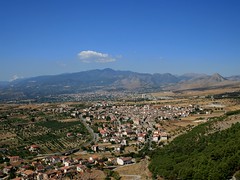
Prospettive dal Dolcedorme
Photo of Calabria, Italy taken by PhotoLab XL at Flickr Creative Commons

From the Guardian, writer Salvatore Aloïse tells us how the village of Calabria has integrated the refugees.

A non-profit organisation looks out for empty homes and refurbishes them to accommodate refugees. While they wait for the grants given to asylum-seekers, which are subject to long delays, the migrants can use a local currency in Riace, with vouchers bearing portraits of Gandhi, Martin Luther King or Che Guevara. When funds arrive, the shops send the vouchers to the local council for payment.

While they wait for formalities to be completed, the refugees are gainfully occupied. The silence of the streets is broken by the hum of workshops helping them to acquire skills in dressmaking, joinery, pottery or glass-blowing, set up as part of an integration scheme funded by the regional government.

Lubaba, who works at the glass factory, arrived here from Ethiopia three years ago after a long journey. From Libya she travelled to Lampedusa, then started another long trail through various Italian reception centres. Her journey ended in Riace, where she decided to stay. "I have a home, enough to live on, I'm learning a trade, and my daughter was born here," she says.

Around 6,000 refugees have passed through the village over the years. Many move on, but some of them stay and try to start their own craft or retail business.

It is not easy, as we heard from an Afghan woman from Herat who left home with her two children when her husband died, finally opening a shop selling knitwear in the village. "We make a living. In the winter it's OK, but selling woolly jumpers in the summer is a struggle," she explains, knitting as her daughter Faeze looks on.

Faeze is in no doubt about her future here in Italy. Speaking Italian with a powerful Calabrian accent, she says she feels "like the others at school". More than 200 refugees like herself and her family have chosen to settle permanently in Riace.

Saturday, February 12, 2011

Italy sees increase in Tunisian refugees

Italy has long struggled with refugees crossing the ocean from North Africa. The people leave from ports of  Africa hoping to survive the trip in rickety boats. They hope to arrive to Italy to seek more economic opportunity. The rash of protests and revolutions throughout North Africa has helped to increase the number of people appearing on Italy's shores.

From the Times of Malta, this AFP article says that Italy is asking for emergency assistance from the EU to help with the increase of refugees. Italy is asking for the EU to patrol the Tunisian coast to intercept people who hope to land in Europe.

“We are asking for an immediate response from the European Union to a situation that Italy cannot deal with on its own,” it added.

Weary-looking immigrants were given blankets and checked out by health officials yesterday as they stepped off dilapidated fishing boats on the tiny island of Lampedusa – some 110 kilometres from Tunisian shores.

Nearly 1,000 immigrants have been brought to the Mediterranean island by coast guards in the past 24-hour period and more boats have been spotted. Most of the new arrivals are sleeping out in the open on the pier in Lampedusa.

“There are people fleeing the strikes and poverty. Some have made asylum requests, others just want to wait and see what happens in Tunisia,” said Federico Fossi, a spokesman for the UN High Commissioner for Refugees (UNHCR).

Ms Fossi said a total of around 1,700 Tunisian immigrants including 50 children have arrived in the 20-square-kilometre island since the fall of President Zine El Abidine Ben Ali on January 14 and the ensuing weeks of unrest.

“There is a risk of a real humanitarian emergency,” Interior Minister Roberto Maroni warned, saying that the uprisings in Egypt and Tunisia had triggered a “mass flight” by immigrants towards Italian shores.

Thursday, October 07, 2010

The gap in Global Fund pledges

A couple of days ago the United States announced an increased pledge to the Global Fund on AIDS, Malaria and Tuberculosis. Several other governments have also increased their pledges, while Italy and Sweden have so far pledged no new contributions. In all $12 billion dollars have been pledged to the Global Fund, but the fund and many activists were hoping for 20 billion.

From this transcript from the Australian Broadcasting Company, reporter Sarah Hawke gives an Australian perspective on the pledge gap for the Global Fund.

SARAH HAWKE: The Director of the HIV-AIDS Project at the Lowy Institute for International Policy in Sydney, Bill Botell says the fund has also had longer term impacts.

BILL BOTELL: Levels of HIV infection have started to stabilise and in many countries have started to fall quite dramatically as people have got access to treatments. We've seen very encouraging progress on malaria and tuberculosis as well.

SARAH HAWKE: Bill Botell has been in New York this week for the UN discussions on the next three years of funding.

Forty countries committed $11.7 billion. The UN was hoping for $13 billion. Poverty and disease advocacy groups wanted $20 billion. Mr Botell says it appeared the Global Financial Crisis dented many commitments.

BILL BOTELL: From some of the donors yes there's been a real problem in their capacity to pay. Italy and Sweden for example have not contributed at all. I'm very glad to say though that some of the other donors, including Australia, have really stepped up to the mark and tried to fill that gap. But it was one of a very small number of countries that actually did step up to the mark.

SARAH HAWKE: What do you think it does actually mean on the ground? Are there going to be certain programs that will be looked at, or various strategies?

BILL BOTELL: That shortfall, of a couple of billion dollars means that funds to take more people on to HIV treatments, for malaria bed nets and for tuberculosis treatments won't be able to be paid for and that will translate into hundreds of thousands if not millions of people dying untimely deaths.

Monday, September 28, 2009

VIDEO: Illegal migrants caught in poverty-trap

Reuters Helen Long reports on African migrants who travel to Europe in the hopes of good jobs. However, the migrants instead get caught in a poverty trap.


Thursday, July 30, 2009

New report says 3 million Italians are in poverty

A new study says that three million people in Italy live in absolute poverty. The statistics service ISTAT defines absolute poverty as having less than what is deemed essential for life.

From this Agence France-Presse story that we found at News.Com.Au, we read more stats from the survey.

Absolute poverty is defined by the "incapacity to acquire goods and services necessary to attain a lifestyle held as the minimum acceptable,'' which means everything from food, clothing and education to medical care or entertainment.

The number of families falling below Italy's poverty line is 1.126 million, the institute's report said, 2.893 million individuals or 4.6 per cent of the population, although the numbers are broadly in line with 2007 figures.

In the southern Mezzogiorno region, the rate has shot up from 5.8 per cent to 7.9 per cent in the new annual results.

Monday, July 06, 2009

A preview of the G-8

The G-8 begins to meet tomorrow in Italy. There is a lot of concern amongst anti-poverty activists as to how much the issues of poverty will be addressed at the meeting. Host country Italy has not done well in meeting their commitments to fund aid to the under-developed world. If fact, Italy has cut back on some of the funding.

So during tomorrow's three hour meeting food security will share the agenda with global warming. As a preview of what might be talked about in regards to food security, we turn to this article that we found at the Irish Times, writer Jamie Smith fills us in.

The G8 states are also expected to sign up to a new food security initiative, which aims to replace food aid with more sustainable aid to farmers in the developing world. The Financial Times reported yesterday that the G8 would set up an $12 billion fund to disburse over three years to reverse “the tendency of decreasing official development aid and national financing to agriculture”. The US and Japan are likely to supply $6-8 billion and the EU and Canada the rest.

The initiative may dampen criticism aimed at G8 states for failing to live up to commitments they made in Scotland in 2005 to halve world poverty and hunger by 2015. Since this announcement it is estimated a further 150 million people live in hunger, bringing the global total to more than one billion, says Tom Arnold chief executive of Concern. He said he welcomed the announcement, which mirrored many of the recommendations in the Hunger Task Force report commissioned by the Government.

The food security initiative represents a major shift in US policy. It is the world’s biggest food aid donor disbursing $2 billion per year to poor countries, much of which was provided by US farmers – a powerful lobby in Washington.

Thursday, July 02, 2009

Comment: World Vision's wishes for next weeks G-8

With the G-8 meeting in Italy next week, aid organizations around the world are making their voices heard on what they would like to see done. Advocacy campaigns director for World Vision Patrick Watt, has written an opinion that the G-8 needs to firm up their commitments to aid that they made back in 2005.

From The Huffington Post, we find this snippet of Watt's commentary

Four years on, what was dubbed a 'Marshall Plan' for Africa in 2005 risks disintegrating into a partial plan:

* While non-G8 donors, responsible for a quarter of the total aid increase, are delivering on their side of the deal, aid from the G8 countries has actually fallen. So far, G8 countries have raised aid by just one third of the total they pledged in 2005.
* Italy, the host nation, continues to slash its aid spending, and now gives less than a fifth of one per cent of its national income to poverty reduction.


Failure to deliver on recent promises will cost the G8 heavily in terms of credibility. But more importantly, it threatens a huge social cost at a time when the global recession is hitting low-income countries hardest.

The World Bank estimates that as many as 2.8 million additional child deaths could result between now and 2015 unless urgent action is taken to mitigate the impact of the economic slowdown on household income and public spending.

Some G8 countries -- most notably Italy -- have suggested that the fiscal squeeze in Europe and North America makes delivery of current pledges unaffordable. But on closer scrutiny this is a flimsy alibi: the global aid increase promised by 2010 is equivalent to just 2% of the total stimulus package announced for G8 countries at the London G20, and would be equivalent to about 1% of public spending in most EU member states.

Inaction by the G8 is the real unaffordable luxury, not least from the perspective of the 9.2 million children who continue to die each year from easily preventable disease. Where the G8 has delivered additional aid for areas such as health, it has made a lasting and positive impact.

A 90% reduction in deaths from measles in Africa since 2001, and provision of life-saving antiretroviral drugs for 4 million people with HIV and AIDS would not have been possible without the support of G8 countries. This is a platform that needs to be built on when the G8 meet in L'Aquila, not squandered.

Friday, February 20, 2009

Annan and Geldof meet Italy's Premier

We love the quotes that come from Sir Bob Geldof, they have a real "punk rock" quality to them.

We found some more quotes from Bob Geldof today, as he and former UN secretary Kofi Annan met with Italy's Premier Silvio Berlusconi. Italy holds the chair of the G8 this year, so the two activists pressed the Premier to keep Africa poverty a focus as he leads the group of the wealthiest nations.

This Associated Press article that we found in the International Herald Tribune covered the meeting, and gave us the quotes from Sir Geldof.

"In richer countries this crisis is resulting in bankruptcy, unemployment, personal misery and fear for the future," the former U.N. chief said. "But for many in Africa, the effects are life-threatening."
...

Annan, who is chairman of the Africa Progress Panel, a group devoted to promoting development, warned that lives and progress were at risk in Africa because of the financial downturn. And he urged rich nations to keep up their commitments in the face of the crisis.

"The impact is profound, and deepening," said Annan, citing decreasing trade and foreign investment, drying up credit and slumping revenues. He said hunger will likely increase, school attendance will drop, and women and children will be the hard hit.

The IMF has revised downward its estimate for growth in Africa in 2009, Annan told a meeting organized by the Italian chapter of the Aspen Institute.

Geldof challenged Berlusconi to prove his leadership and be at the forefront of efforts to halve extreme poverty around the world by 2015.

"Don't talk to me about the financial crisis," Geldof told reporters. "Whatever financial crisis we meet, it is life or death" for people in Africa.

"This money does not go into some black hole, it goes into an empty stomach," Geldof said

Tuesday, November 04, 2008

Poverty stats for Italy

The stats bureau Istat has released some numbers on the amount of people in poverty in Italy. Two weeks ago an the Charity Caritas said that 1 in 4 Italians were living in poverty.

As we find in this story from the ANSA.it millions live on less than 600 euros a month.

ANSA.it November 4th

Around 7.5 million Italians, or 13% of the population, are living below the poverty line on less than 600 euros a month, national statistics bureau Istat said Tuesday.

Around 170,000 people are considered extremely poor, living on a monthly income far below the poverty line, according to the report.

The figures for 2007 were largely unchanged compared to those for 2006, although families living in Tuscany improved their overall living conditions over the year.

Veneto remained the richest region, with just 3.3% of residents living below the poverty line, while Sicily was the poorest with 27.6% struggling to make ends meet.

Southern Italian families were four times more likely to be poor than those living in the rest of the country, according to the report.

Istat said a total of 11.1% of families were living below the poverty line while 4.2% were hovering just above. A further 3.7% were considered 'at risk', while 81% could be classified as not poor.

The bureau set Italy's poverty line at a monthly spending capacity of 600 euros for a single person, 1,607 for a family of four people and 2,637 for a family of six or more.


Friday, September 19, 2008

Sea of hope and desperation

from the Age

by Paola Totaro

THE SMELL will remain imprinted forever, an acrid cocktail of sweat, urine and sheer exhaustion, the odour of hope and the stench of despair. In surreal, dignified silence, men, women and tiny children hobble down the gangplank, a sea of haunted faces clutching little more than each other or a plastic water bottle, long since sucked dry.

An infernal scene, it is played out daily on the vast concrete wharf that dominates the tiny Italian port of Lampedusa. There is no moaning, no wailing, just the deep drone of boat engines churning water, the shout of coast guards mooring, a seagull's cry. On land, safe and at last shaded from the vicious 40-plus-degree heat, the relief is palpable, if fleeting.

Between January and August, nearly 20,000 people made the perilous overland journey to the coasts of Libya or Tunisia, to cross the Mediterranean and land on Italy's southernmost territory, the islet of Lampedusa. Many have already spent weeks, months and even years on the road and once on the coast, must entrust what little money they have left to the local criminal syndicates that traffic in human beings, and smaller and ever more dangerous boats.

So far in 2008 an estimated 600 souls have perished at sea trying to get to Italy, while more than 18,000 are estimated to have disappeared or died en route from Africa to Europe since the mid-1990s. Today, the fishermen and commercial trawlers that work the waters between North Africa, Sicily and Malta haul in human remains with horrible regularity but admit that they no longer bother to report their finds to the authorities. Lampedusa's fishermen state openly, if anonymously, that they simply can't afford the loss of a day's income while the slow grind of bureaucracy works through the grisly paperwork.

Dr Marinella Cantalice, of Lampedusa's Medecins Sans Frontieres, says the provenance of the "clandestini" (illegals) has changed over the past two years: "It used to be that they came primarily from the Mahgreb (Algeria, Tunisia, Morocco, Sudan). Now, 70% are from the sub-Saharan regions and 30% of those from the Horn of Africa: Eritrea, Ethiopia, Somalia. They arrive after long journeys, dehydrated, stiff, sore, with swollen feet and sometimes burned by the mix of salt, urine, petrol."

Laura Boldrini, spokeswoman for the UN's High Commissioner for Refugees, says that in the past year, the number of women and children arriving on the boats has doubled. This year, 678 minors have reached Lampedusa alone, without family.

"The characteristics, the profile of the African immigrant has changed. It is no longer merely about finding work and a better economic life but about surviving war, persecution, famine," she says. "The Mediterranean is increasingly Africa's roadway to political asylum … we cannot pretend that this is not happening, nor can we ignore the phenomenon any longer."

We are asked over and over again by asylum seekers: "What is it like in Australia? Is it like here? Is it true that they let people, even children, drown when they come on the boats? Come, come and see what we do."

THE SIGHTINGS come at all times of the day. During summer, the seas are flat and calm and traffic increases dramatically: The Age spent a week on call with Medecins Sans Frontieres and the Guardia Costiera (Italian Coast Guard), and on the Wednesday, no less than seven boats arrived on the island.

The largest, a 15-metre wooden fishing vessel was reported early in the morning by a yacht that radioed its position to the coast guard. Within half an hour, a launch loaded with water and medical supplies steamed out of port with a crew of seven including Order of Malta medical volunteers, a doctor and specialist nurse.

The boat's commander, Gildo Damanti, estimated it would take close to two hours to reach the stricken boat: "All we know is that there are many, many people on board. We have water and some food but we cannot make a decision on what to do and how to get them in until we get there."

The trip, under a baking sun, seemed interminable, the gallows humour of the crew and medical staff made clear the high tension. When binoculars discerned two pinpricks on the horizon — the white sails of the yacht within a discreet distance of a light-blue wooden boat — the launch buzzed into frenetic activity. An aerial swoop by the coast guard's plane radioed details and the crew and medical back-up donned rubber gloves, sterile suits and masks. Once the boat came into view, a hush fell over the launch.

"Dear God, how many?" whispered a crewman.

The sight was unforgettable, an almost impossible number of human beings perched on the deck, on the roof, on the sides, hanging over rails, below deck and sitting on top of each other. The desperation was visible, dry cracked lips, shouts for "water, water", but when bottles were thrown over, fights broke out, leading the boat to list dangerously and prompting the coast guards to wave axe handles and a wooden oar above the men's heads in a distressing — but necessary — attempt to restore order. The sheer numbers, 332 men and women, meant it was impossible for one launch to take them all, and an attempt to start the fishing boat's engine and tow it to shore was thwarted by the refugees. Terrified they might be abandoned, they threw the engine keys into the sea. It took another three hours before a second launch arrived, let alone to calm the migrants enough to bail water while they waited. Women, 45 in total, were transferred first: most were from Nigeria and had been travelling for weeks — one said three months — before they began their sea journey. They had been without water or food since they sailed from Africa four days before.

Exhausted, dead-eyed, they spoke of fleeing violence: "I have my brother, my daughter … my parents dead, they shoot my mother, I decide to run," Eli, a 36-year-old Nigerian woman told The Age.

Said 26-year-old Charity before dissolving into sobs: "My father was a soldier. He was shot in the war and he was dead and my mother had nobody to take care of me and my brother and two children … I don't know what has brought me to this place, I don't know, I don't know."

Despite the difficulty of the task, the crew showed extraordinary compassion. One sat on the front deck, in the baking heat and smell, singing songs to keep the men's spirits up on the long, slow limp back to port. "Being useful to other human beings is half the satisfaction of the job," said one of the crew, Giovanni Iuculano.

"Our work means something … this boat alone has saved 2000 people during the last three years. We fish out 10 to 15,000 out of the sea every year," said his colleague, Vincenzo Caracausi.

On land, after triage by the Medecins Sans Frontieres crew, the new arrivals are quickly loaded onto buses and ferried to a rocky valley once used to bury American troops during World War II. Here, out of sight of tourists and in a centre rebuilt a year ago with European Union money — originally it was just a cluster of rundown military barracks — migrants are given clean clothes, shoes and a telephone card. They are photographed, identified (if possible) and after a few days' rest, are sent, by air, ferry or hydrofoil to one of Italy's mainland centres, where they await the process of applications for papers and asylum.

Sebastiano Maccarrone, the centre's director, is ferocious when I use the words "detention centre" during our first visit. His charges are "ospiti" (guests) and they are not held against their will, he insists.

"These poor desperate people come to us, to Europe to find a new life and to find succour. This is a welcome centre."

Behind big metal gates, guarded by armed soldiers and police, locked in their hundreds into hot, concrete, segregated yards, the word "welcome" seems hollow. And yet a couple of days later, when we visit again to try to find the young women we interviewed on the coast guard launch, they are clean, rested and manage to smile despite their anxiety.

The Lampedusa operation costs Italian taxpayers an estimated 50 million euros ($A91 million) a year, a cost that has increasingly infuriated the island's locals. Their own town centre is reminiscent of a Third World shantytown, with decrepit buildings, potholed roads, a crumbling school, ancient desalinator and no hospital. Lampedusa's administration falls within the prefecture of Agrigento in Sicily — which happens to be 250 kilometres away — while Tunisia is just 113 kilometres away.

The irony is that while locals complain, the African exodus has created a state-funded service industry in which local contractors vie to win multimillion-dollar tenders to provide clothes, food, security and transport services to the centre each year.

Then there is the hypocrisy of the Government of Silvio Berlusconi and the anti-immigration Northern League, who gleefully whip up xenophobia as a campaign tool but stay silent about the exploitation of African illegal immigrants who pick the fruit and crops produced by southern Italy to feed the north.

The Italian Medecins Sans Frontieres recently prepared a major — and horrifying — report about conditions for these workers. (Aptly, they titled it The Fruits of Hypocrisy).

On Lampedusa, in its restaurants, its bars, its shops, the locals preface their observations with "I am not racist, but …" before delivering diatribes about the boat people's effect on tourism. The local Mayor, Bernardino de Reubis, told an Italian newspaper last week that he is "not a racist", while observing that "the stench of Negro flesh stinks even when it is washed".

In an interview with The Age a couple of days later, he was mortified, insisting he had been taken out of context: "I was talking about what happened last month when 1900 people were crammed into the centre in 40-degree heat … in such terrible conditions, white flesh, any flesh would smell."

De Reubis said that as a Catholic, offering help to the less fortunate is an imperative. But now, the island's own people need help too. Angela Maraventano, his deputy, is a senator for the anti-immigration Northern League who has not only called for the immigration centre to be moved to a ship offshore but echoed a call by league leader Umberto Bossi, who argues the best way to stop the exodus from Africa is to shoot over boat people's heads "just as a warning".

SEEKING REFUGE

■Italy has an estimated 3.7 million legal immigrants.

■Estimates of illegal immigrants range from 600,000 to more than 800,000.

■13% of illegal immigrants arrive by sea.

■250,000 are estimated to have arrived via Lampedusa since 1993.

■Italy began anti-immigration military swoops in May and expulsions rose 15%.

■20,000 of Italy's 55,000 prisoners are immigrants.

Paola Totaro is Europe correspondent.

Link to full article. May expire in future.

Tuesday, February 12, 2008

RIGHTS: Widows Face a Life of Quiet Destitution

from IPS

Nergui Manalsuren

UNITED NATIONS, Feb 12 (IPS) - Many years ago, as Dr. Mohini Giri was walking down a street in Vrindavan, India -- known as the "City of Widows" -- she noticed the body of a woman who had passed away on the road. Animals were feasting on the corpse, and no one had tried to move her or cremate her.

Giri asked a few young men to help her lift the body. They promptly refused, saying that to touch a dead widow would bring years of bad luck and impurity. Dr. Giri was shocked at their callousness and ultimately got help from other widows, who cremated the woman together.

The story inspired Giri, a widow herself, to found the Guild of Service, an organisation committed to the empowerment and rehabilitation of Indian widows.

The Guild of Service runs a shelter for 120 widows in Vrindavan, Uttar Pradesh, where there are at least 6,000 widows who have fled to the holy city from lives of trauma in West Bengal and other areas. Many survive by singing hymns in the temples for a cup of rice or by begging on the streets, and some are forced into prostitution.

"Earlier, widows were forced to commit sati [suicide] by burning themselves on their dead husband's funeral pyre, but that evil practice was abolished by the great social reformer Raja Rammohan Roy," Surabhi Chaturvedi, a counselor at the of Guild of Service, told IPS. "But still widows continue to live a life of quiet destitution."

"In Kashmir, a conflict-ridden state, there are many women who are widowed due to terrorism and militancy," she said. "We have a shelter home for widows and children affected by militancy, called Rahat Ghar (Rahat meaning solace) in Srinagar. We also equip those widows with vocational training and various skills that will enable them to stand on their own feet again."

The Guild also works with government agencies and other organisations to educate widows about their legal rights, helping them to open bank accounts and secure the state pensions they are entitled to.

Widows are stigmitised by society not only in India, but across the globe. Worldwide, every day, about 100 million widows and their children are ostracised, exploited, and harassed by the societies they live in, according to the Loomba Trust, an international charity based in Britain that aims to educate the children of poor widows throughout India.

"For these widows, the widowhood means denial of basic human rights," Cherie Blair, president of the Trust and wife of former British Prime Minister Tony Blair, said at an event at the U.N. last November to promote widows' rights.

In some countries, widows are subjected to constant harassment. They not only face legal obstacles to inheriting property, but are also unable to send their children to school.

That makes many widows and their children "the most vulnerable and the poorest of the poor," Blair said.

In a statement urging the U.N. to protect widows from abuse and exploitation, Blair referred to the Universal Declaration of Human Rights that provides a roadmap to guarantee the rights of all individual everywhere in the world.

She noted it was a widow who led the meeting that approved the Declaration in 1948. That meeting was chaired by Eleanor Roosevelt, wife of the U.S. president Franklin D. Roosevelt.

Blair has called for the world body to adopt a resolution designating Jun. 23 as International Widows Day. The Loomba Trust was established on Jun. 23, 1997 to help poor widows in India and other developing countries.

The charity's work has been widely acknowledged by some of the world's most prominent figures, such as Laura Bush, Hillary Clinton, and Virgin Group's chairman, Sir Richard Branson. Though pleased with their response, Blair thinks it is "not enough" to address the problem. She wants the global community to recognise it "on a large scale".

A recent report by the Loomba Trust report points out that in several developing countries, widows are forced to marry their husband's brothers or enter into polygamous marriages, and are often subjected to sexual abuse by male members of their husband's extended families.

Cheated out of their inheritance, many widows are kicked out of their family homes along with their children. They are often forced to live on the streets, where they fall prey to the worst kinds of abuse, violence, and sexual exploitation.

In Afghanistan, Blair said, decades of fighting have left two million widows who are not allowed to make a living outside their homes because it is against custom. The suffering of women in other conflict zones is no less acute.

Most war widows cannot afford to send their children to school or feed them properly, said Blair, adding that the families headed by widows are getting caught in the vicious circle of illiteracy and malnutrition.

Data gathered by the Loomba Trust shows that in several countries, widows have minimal or sometimes no societal support, but are also the only breadwinners of the family. They run a whopping 84.4 percent of female-headed households in Iran, and 79 percent in Indonesia and Burma.

According to the Trust, widows who are the sole supporters of families are among the poorest people in urban informal labour markets and constitute large numbers of the marginally employed and rural unemployed.

"The appalling treatment just entrenches the cycle of poverty and deprivation," said Blair, "because if the mother has no money, the children are pulled out of school. With no education, they are doomed to spend their lives in most menial jobs if they get work at all."

Blair said it would be "impossible" to achieve the Millennium Development Goals (MDGs) with the increasing number of women becoming widows due to conflicts and the spread of HIV/AIDS.

The MDGs are a series of targets with a deadline of 2015. They include a 50-percent reduction in poverty and hunger; universal primary education; reduction of child mortality by two thirds cutbacks in maternal mortality by three quarters; the promotion of gender equality; and the reversal of the spread of HIV/AIDS, malaria, and other diseases.

Although the U.N. promotes the empowerment of women in political participation, financial security, and gender equality in developing nations through agencies such as UNIFEM and UN-HABITAT, Blair said it is important for the world body to increase its focus on the micro level of emancipation of widows.

The report says that most widows in developing countries are also struggling to survive in the face of violent physical and mental abuse. Many widows are forced into prostitution or become victims of human trafficking.

Blair told IPS that even in countries where laws exist to prevent the abuse of widows, lack of awareness and illiteracy impede legal aid.

Thursday, October 04, 2007

Poverty: ISTAT, No Fall In Italy (11. 1 per cent of Families)

from AGI

The number of poor people in Italy is not on the decline: there are 2 million, 623 thousand families living un the poverty level, 11.1 per cent of a total of 23 million.

Overall, there are 7 million 537 thousand people living in poverty, equal to 12.9 per cent of the entire population. The figure, which relates to the year 2006, comes from state statistical agency ISTAT, which in its regular report reveals how the incidence of poverty has shown no variation since 2005.

Inside the group of families living in poverty, not all are in the same condition. 4.8 per cent (equal to roughly 1,142,000) are "undoubtedly poor", having a monthly level of spending which is 20 per cent below the standard, or 970.34 per two-person family.

Here is yet another confirmation of the presence of two Italies: three quarters of these "undoubtedly poor" families live, in fact, in the South.

Breaking down the figure of 11.1 per cent of poor families, 3 per cent have spending levels not much lower than the poverty limit (within a boundary of 10 and 20 per cent): this accounts for roughly a third of the total of poor families.

The remaining 3.3 per cent have levels of spending not more than 10% below the poverty line. These are, then, families living very close to the threshold that defines whether or not they are poor.